
How to Choose Binoculars: Magnification, Light and Fit
Learning how to choose binoculars starts badly for most people: every pair is sold on two numbers, and almost everyone reads them backwards. Higher magnification looks like the better buy and usually is not. The pair you actually enjoy using is decided by light, steadiness and weight — none of which appear in the headline.
This guide on how to choose binoculars explains what the numbers mean, which ones matter for what you do, and what you can safely ignore.
Key takeaways
- 8×42 suits most people better than 10×50.
- Above 10x, handshake ruins the view.
- Exit pupil decides low-light performance, not the objective size alone.
- The pair you carry beats the pair you leave at home.
What 8×42 actually means
The first number is magnification: an 8x pair makes an object appear eight times closer. The second is the diameter of the front lenses in millimetres — the objective lenses, which gather light.
So 8×42 means eight times magnification with 42 mm objectives. That is the most popular configuration in the world for a reason, and it is a sensible default if you are unsure.
Magnification: why 10x is not simply better than 8x
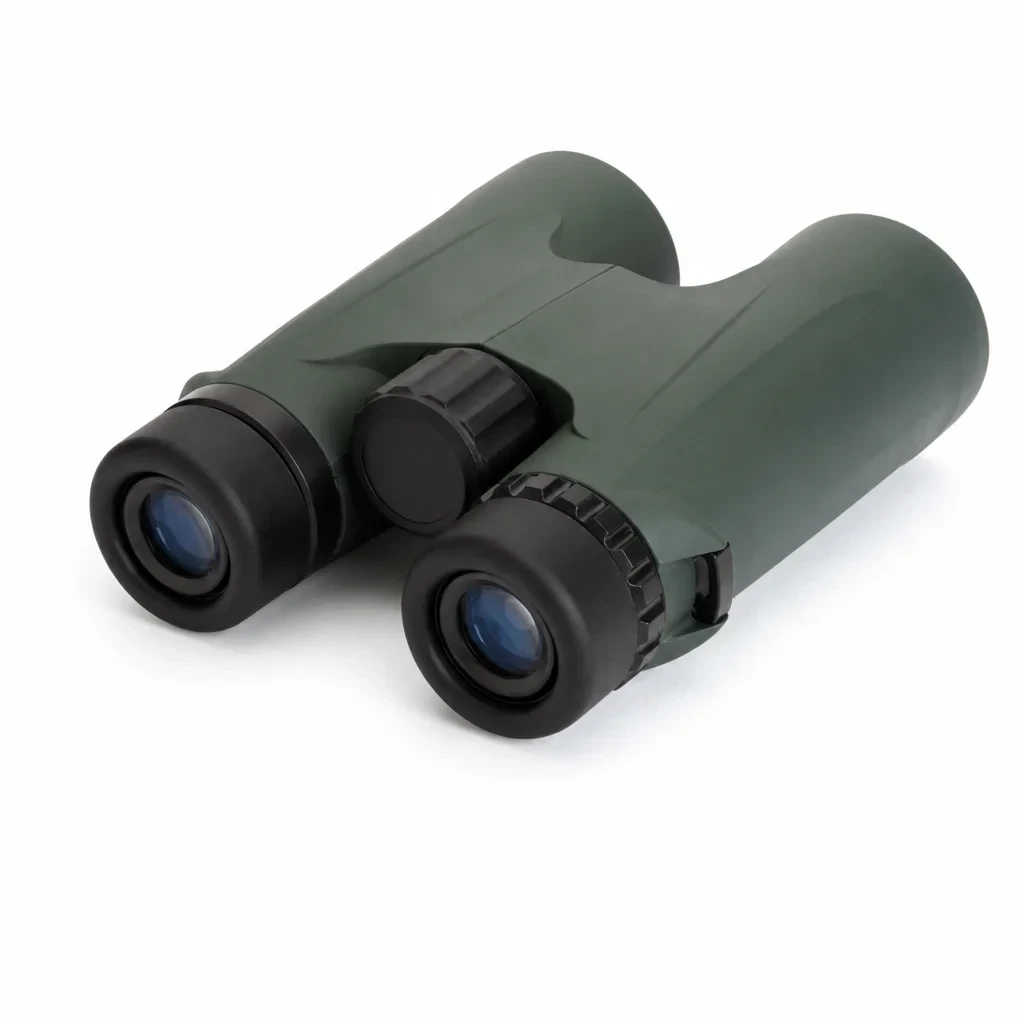
Magnification multiplies everything, including the tremor in your hands. At 8x a steady image is easy. At 10x most people see a visible wobble. At 12x and above, handheld viewing becomes tiring within a minute and you will want a tripod.
Higher magnification also narrows your field of view and darkens the image. You see less, less brightly, and less steadily — in exchange for objects looking slightly larger.
Choose 10x only if you glass open country at distance and can brace against something. For woodland, birds, hiking and general use, 8x is the better tool.
Objective lenses gather light, they do not zoom
A 50 mm objective collects more light than a 42 mm one, which helps at dawn and dusk. It also adds bulk and weight — often 200 g or more per pair.
For daylight use the difference is barely visible. For first and last light it is real. Decide based on when you actually go out, not when you imagine you might.
Exit pupil: the number nobody prints on the box
Divide the objective size by the magnification and you get the exit pupil in millimetres — the width of the beam of light reaching your eye.
- 8×42 → 5.25 mm. Bright in almost any light.
- 10×42 → 4.2 mm. Noticeably dimmer at dusk.
- 10×50 → 5.0 mm. Bright, but heavy.
- 8×25 compact → 3.1 mm. Fine in daylight, poor at dusk.
A young eye opens to around 7 mm in darkness; by middle age it is closer to 5 mm. Anything above about 5 mm of exit pupil is comfortable for most people in low light. Below 4 mm you will notice the image going grey early in the evening.
Field of view: how much you can find
Field of view is usually given in metres visible at 1,000 m, or in degrees. A wide field makes it far easier to locate a moving animal and to follow it once found.
This is the specification people ignore and then regret. If you watch birds, or anything that moves quickly through cover, a wide field of view will do more for your enjoyment than an extra 2x of magnification.
Roof or porro prisms
Porro prisms are the classic zigzag shape. They are optically efficient and cheap to make well, which means a budget porro often outperforms a budget roof-prism pair. They are bulkier and less weatherproof.
Roof prisms give the straight, slim barrels most modern binoculars use. They are easier to seal and carry, but need expensive coatings to reach the same brightness. In the lowest price brackets, that is where corners get cut.
Under roughly €100, a good porro pair usually beats a roof pair at the same price. Above that, roof prisms win on handling.
Coatings and glass, in plain terms
- "Fully multi-coated" — every glass-to-air surface is treated. This is the phrase to look for. "Coated" or "multi-coated" alone means less.
- BAK-4 prisms — better than BK-7 for edge sharpness and a round, even exit pupil.
- ED or HD glass — reduces colour fringing around high-contrast edges. Nice, not essential.
- Phase correction — only applies to roof prisms, and genuinely improves contrast.
Eye relief matters if you wear glasses
Eye relief is how far your eye can sit from the eyepiece and still see the full image. If you wear glasses, you need roughly 15 mm or more, and eyecups that twist down out of the way.
Too little eye relief with glasses on means looking through a tunnel. It is the single most common reason people find a pair uncomfortable without knowing why.
Weight is a specification, not an afterthought
A full-size 10×50 pair runs 900 g to 1.1 kg. An 8×42 is typically 650–750 g. A compact 8×25 can be under 350 g.
Around your neck for a day, that difference decides whether the binoculars come with you next time. A modest pair you carry everywhere is worth more than an excellent pair left in the car.
If you do carry a full-size pair regularly, a harness that spreads the load across your shoulders costs little and changes the experience completely.
Waterproofing and fogproofing
Look for nitrogen or argon purged and O-ring sealed. Purging removes the moisture inside the barrels, so they do not fog internally when you step from a cold morning into a warm car — internal fogging cannot be wiped away.
"Water resistant" is not the same as waterproof. If you use them in real weather, this is worth paying for.
What you can safely ignore when you choose binoculars
- Zoom binoculars. Variable magnification compromises brightness, sharpness and field of view at every setting.
- Ruby-coated or brightly tinted lenses. A marketing finish that removes light rather than adding it.
- Very high magnification claims such as 20x or 30x handheld. Unusable without a tripod.
- Built-in cameras and compasses on inexpensive pairs. Both are usually poor, and add weight.
How to choose binoculars: sensible starting points
- General use, hiking, wildlife — 8×42, fully multi-coated, waterproof.
- Birdwatching in cover — 8×42 with the widest field of view you can find.
- Open ground and long distance — 10×42, braced or on a tripod.
- Dawn and dusk — 8×42 or 8×50 for the larger exit pupil.
- Packing light — 8×25 compact, accepting weaker low-light performance.
Frequently asked questions
Are 10×50 binoculars better than 8×42?
Not for most people. They are brighter at dusk and show more magnification, but they are heavier, harder to hold steady and show a narrower field. For general use, 8×42 is the more usable pair.
How much should I spend when I choose binoculars for the first time?
There is a large jump in quality between the cheapest tier and the next one up. Beyond a mid-range price, improvements become gradual and mostly matter in poor light. Buy the best sealed, fully multi-coated 8×42 you can afford and stop there.
Can I use binoculars with glasses on?
Yes, if the pair offers around 15 mm or more of eye relief and has twist-down eyecups. Check this specification before anything else if you wear glasses.
What does nitrogen purged mean?
The air inside the barrels has been replaced with dry nitrogen, so no moisture remains to condense on the internal glass during temperature changes. It prevents internal fogging, which you cannot clean.
How to choose binoculars: so which pair should you buy?
For almost everyone, a sealed, nitrogen-purged, fully multi-coated 8×42 with a wide field of view and at least 15 mm of eye relief. It is bright enough for dusk, steady enough to hold, and light enough to carry.
If you are glassing on public land, it is worth checking the rules your state wildlife agency publishes before you go. Move to 10x only when you know you are glassing open ground at distance, and drop to a compact only when weight genuinely decides whether the binoculars come with you.
Where to look next
That is the short answer to how to choose binoculars. Binoculars, spotting scopes and rangefinders live in Hunting, together with the gear that watches while you are not there.
Binoculars cover what you can see now; a trail camera covers what happens when you are not there, and the two work well together. You can also browse the rest of our field notes.