
How to Choose a Trail Camera: A Practical Buying Guide
Knowing how to choose a trail camera matters because it is one of the few pieces of hunting gear that works while you sleep. Set it up right and it tells you what walks through your property, when, and how often. Set it up wrong and you come back to a card full of blurry tails and windblown branches.
This guide covers how to choose a trail camera that earns its spot on the tree: what actually matters when you pick one, in plain terms, and what you can safely ignore.
Key takeaways
- Trigger speed matters more than megapixels.
- Detection range and flash range are different numbers — check both.
- No-glow infrared keeps the camera invisible, but costs you some night clarity.
- Battery life decides how often you disturb the site.
How to choose a trail camera: start with what you need it for
Scouting and security are different jobs. If you are patterning deer on a trail, you want fast triggers and long battery life, and you will check the card every few weeks. If you are watching a gate or a shed, you care more about detection range and night clarity, and you may have power nearby.
Decide that first. Half the specs below stop mattering once you know the answer.
Trigger speed and recovery time
Trigger speed is the gap between the sensor detecting movement and the shutter firing. Anything under 0.5 seconds catches an animal crossing a trail. At 1 second or more you photograph the space where it used to be.
Recovery time is how long the camera needs before it can fire again. A fast trigger with a slow recovery still misses the second and third animal in a group. Look at both numbers together.
Detection range and flash range
These get confused constantly. Detection range is how far the motion sensor reaches. Flash range is how far the infrared light actually illuminates at night.
A camera can detect movement at 30 metres and still deliver a black frame, because the flash only reaches 20. When the two numbers are far apart, trust the smaller one — that is your real working distance after dark.
Image quality: megapixels are not the whole story
Manufacturers advertise numbers like 48 MP, but most of those are interpolated — software enlarging a smaller native sensor image. A genuine 16 MP sensor often beats a padded 48 MP claim.
What to look for instead: sensor quality, lens aperture and how the camera handles low light. If you plan to identify individual animals rather than just count them, resolution starts to matter more. When you compare models, look for a stated native sensor rating rather than an interpolated headline number.
Night vision: three flash types
- White flash — colour photos at night, best image quality, but it lights up and spooks animals.
- Low-glow infrared — a faint red glow, good range, mostly unnoticed by wildlife.
- No-glow (black) infrared — completely invisible. Shorter range and slightly grainier images, but nothing knows it is there.
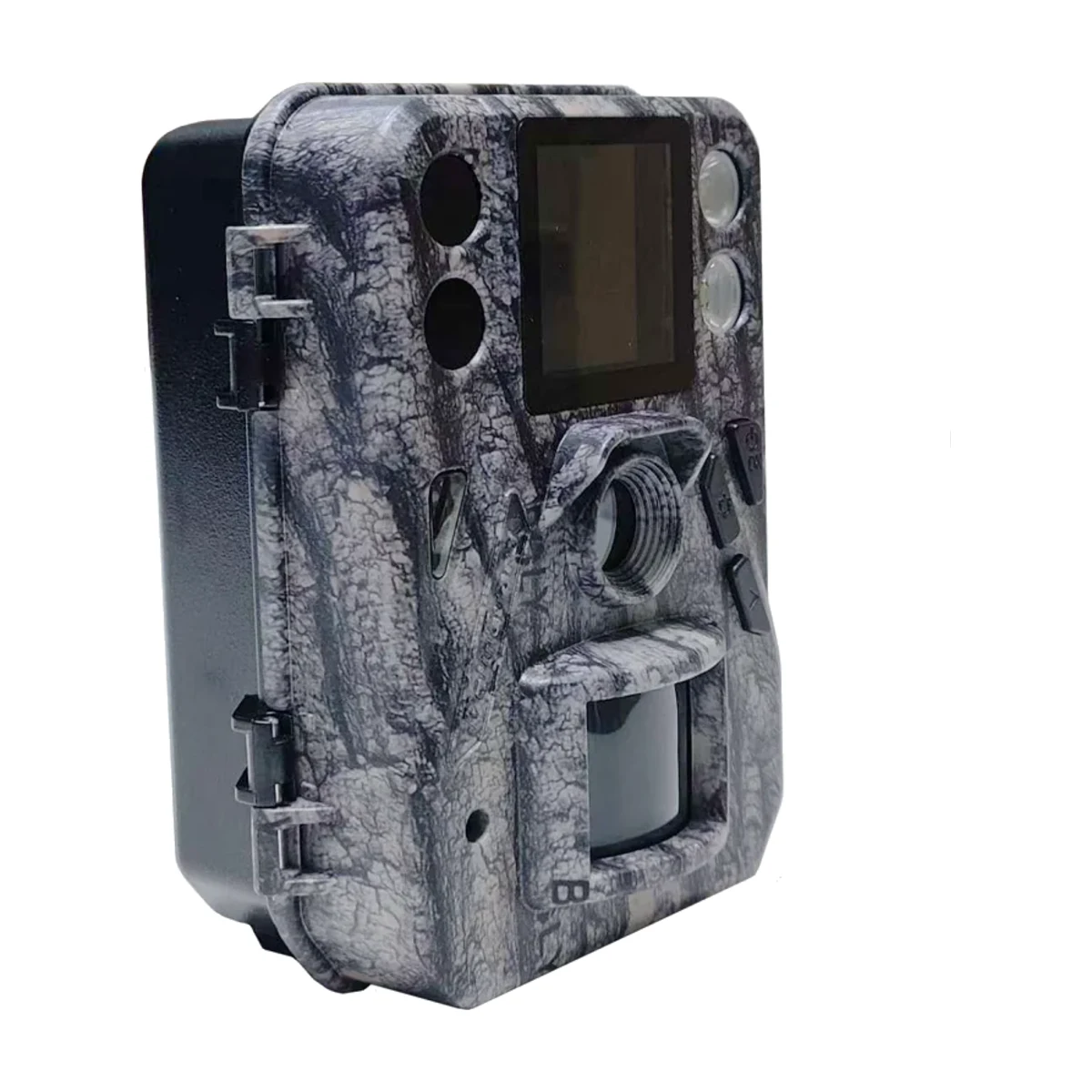
For security work, or anywhere people might find and take your camera, no-glow is worth the trade. Cameras built for this use two 940 nm black IR emitters, which sit outside the visible range for both deer and people.
How to choose a trail camera for battery life: a field problem, not a spec
Every visit to the camera leaves scent and noise. A camera that runs six months without a change is not just convenient — it keeps the site undisturbed.
Cold weather cuts battery life hard. Lithium cells handle freezing far better than alkaline. If the camera has an internal rechargeable pack, check the capacity: a 5000 mAh pack covers a long season without you going near it.
Storage and getting the photos out of your trail camera
Most cameras take a microSD card, usually up to 32 or 128 GB. Video eats space quickly — if you shoot 4K clips, size up.
Cellular cameras send images to your phone and remove the need to visit at all, but they need coverage and a monthly plan. For most people starting out, a card-based camera and a card reader is the sensible choice.
Weather sealing and mounting: how to choose a trail camera that survives
Check the rated temperature range and the ingress rating. A camera rated from -30 °C to 70 °C will survive anywhere in the continental United States.
Look at the strap and mount too. A camera that will not sit still on an uneven trunk will give you a season of sky and dirt.
Five mistakes that ruin trail camera photos
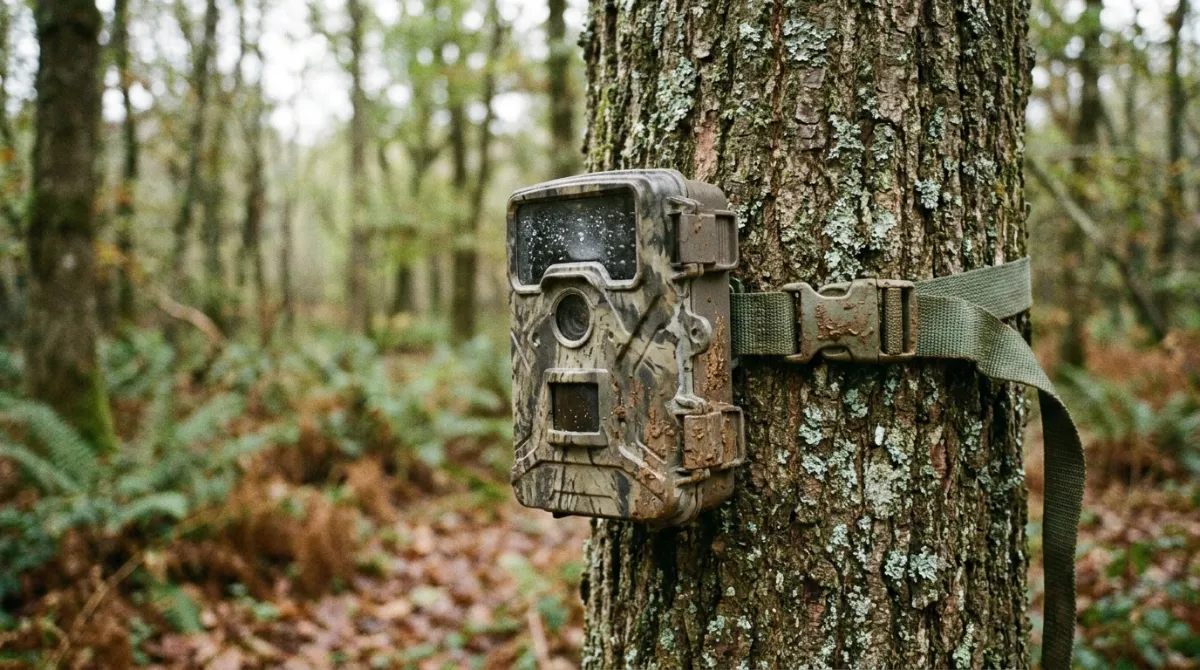
Most of what goes wrong is placement, not price. Knowing how to choose a trail camera is half of it; the other half is where you hang it and how you angle it.
None of these are about the camera. They are about how it gets used, and they account for most of the disappointing cards we hear about.
- Facing east or west. Sunrise and sunset fire straight into the lens and blow out every frame for an hour twice a day. Face north or south.
- Mounting too high. Chest height on a person is roughly body height on a deer. Aim for waist height and tilt slightly down.
- Vegetation in the frame. A branch swaying in the wind triggers the sensor all night. Clear a metre of space in front of the camera.
- Pointing straight down a trail. An animal walking towards the lens crosses the detection zone slowly and often triggers late. Angle the camera about 45 degrees to the trail instead.
- Cheap alkaline batteries in winter. They lose most of their capacity below freezing. Lithium cells cost more and last through the cold.
How many cameras do you actually need?
One more thing before you place them: rules on trail cameras differ by state and by land type, and some public land bans them outright in certain seasons. Your state wildlife agency publishes the current version — check it before you hang anything.
One camera tells you an animal exists. Two or three tell you where it goes and when. If you are working a property rather than a single trail, spreading three modest cameras beats putting the same money into one premium unit.
Start with one in the spot you are most confident about. Add the second only once you know what the first is telling you — otherwise you are guessing in two places instead of one.
Frequently asked questions
Do trail cameras work in the rain?
Yes, if they carry a proper ingress rating. Rain on the lens will soften some images, and a camera mounted under an overhang or angled slightly down sheds water better than one facing straight out.
Can animals see the infrared flash?
Low-glow infrared produces a faint red light that some animals notice, though most ignore it after a few visits. No-glow at 940 nm is outside the visible range for deer and for people. That invisibility costs a little brightness and range.
How long will a set of batteries last?
It depends far more on activity than on the camera. A quiet site might run six months. A busy trail firing hundreds of times a night, with the flash working, can drain the same batteries in weeks. Video drains faster than stills.
Is 4K video worth it?
For identifying an animal, no — a good still does the job and takes a fraction of the card space. For watching behaviour, or for a security camera where you may need to read detail later, it earns its place.
How to choose a trail camera: so which one should you buy?
- Patterning game on a trail: prioritise trigger speed and battery life.
- Watching a gate, shed or driveway: prioritise detection range and no-glow IR.
- Identifying individual animals: prioritise true sensor resolution and night clarity.
Whatever you pick, mount it about waist height, angled slightly down, facing north or south so the sun never shines straight into the lens. That one habit improves more photos than any spec on the box.
A trail camera watches while you are away; a good pair of binoculars covers what you can see for yourself. Most people who own one end up wanting the other.
Where to look next
Once you know how to choose a trail camera, the shortlist gets short. We stock trail cameras with black IR, long-life batteries and true sensor ratings. Compare the current range in Hunting.
Browse the full range in Hunting. If you are putting a kit together, our guides to choosing a spinning reel and choosing a sleeping pad follow the same approach, or head back to the field notes.